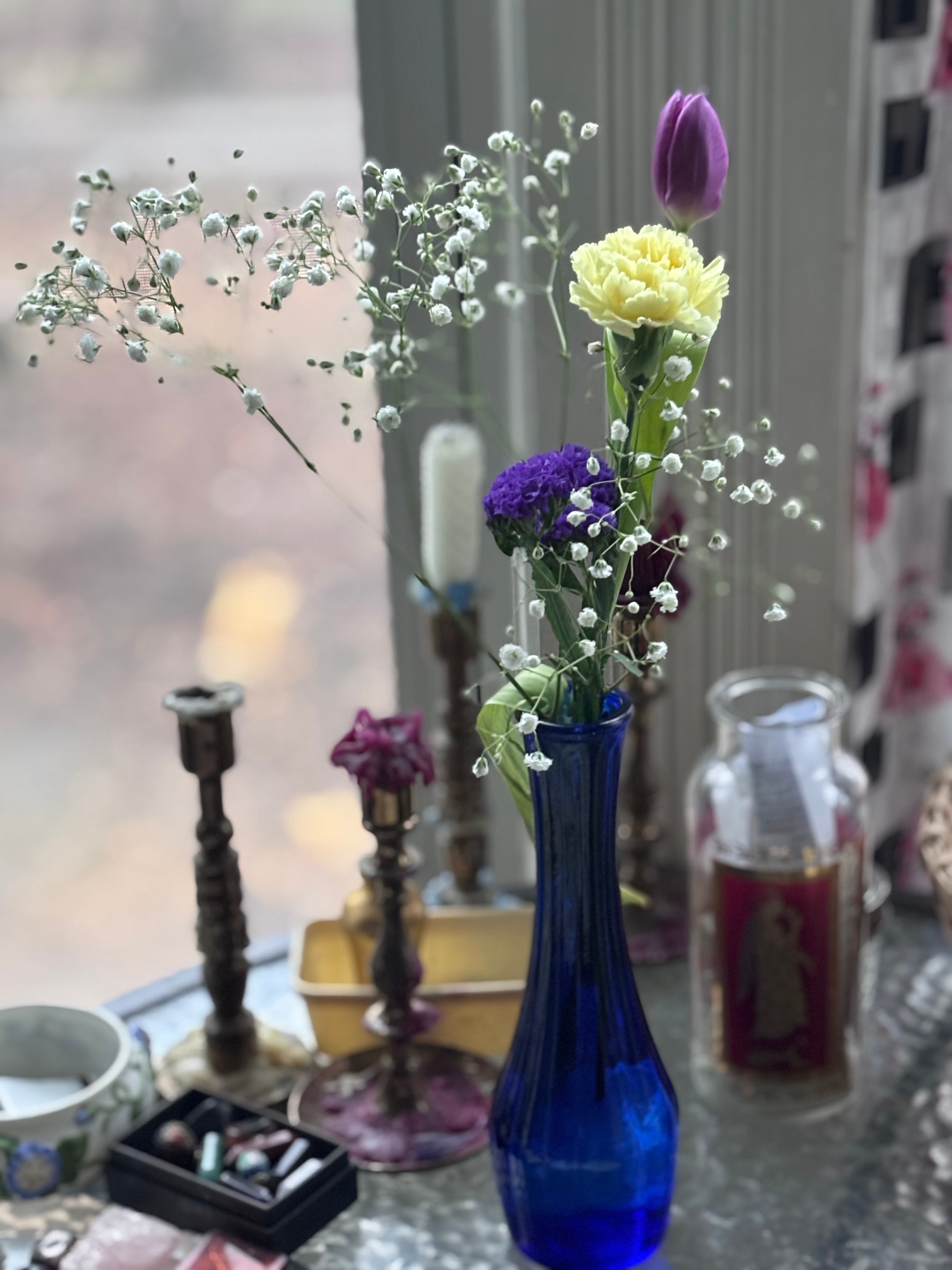
Holy Moly, that was one punishing winter. Shoveling, scraping, bitter cold, biting winds, falls on ice, moods swinging like a metronome, fuel costs rising like an intercontinental ballistic missile … crazy-making. Mother Nature – and other unnamed powers – dealt us a one-way ticket to Nutterville.
Normally I feel a nostalgic sorrow at the passing of both summer and winter, for some reason. It’s as if, “I’ve become accustomed to her face.” And it will be a long while before she rolls around again.
This time I feel nothing but anticipation. Here comes spring, baby. Bulbs emerging. Skunks resurfacing. Birds romping. We’re still in a wacked-out limbo as temps vacillate as the sap runs, and we gradually adjust to the next drastically different season. That’s why a friend said she lives in New England. For the “drastic changes of season.”
Being bounced around inspires fear: is spring really coming, or is this some elaborate ruse by forces outside our control designed to drive us insane with sheer wanting? There certainly seem to be many forces outside our control right now, and I for one don’t like it a bit. I’m taking to the streets, by the Jesus (an old Vermonty expression, that).
Speaking of whom, my pagan inclinations aside, Lent became something oddly sacred when I moved back to Vermont 20 years ago and found a great church. (I realize Dear Reader may find the latter an oxymoronic pairing of words, but I proceed.) I learned that Lent is not supposed to be about self-flagellation or self-denial, but self-reflection and a putting away, perhaps, of thoughts or behaviors that no longer serve us or others. A self-freeing. I super enjoy quiet contemplation as the last snows fly during this odd period of waiting.Importantly, the Filet-O-Fish always goes on sale now. Because of St. Pat’s (O’Fish!) or Lent (fish!), who knows, but the thing is six bucks ordinarily, so have it.
I make lists at summer’s end, the new year, and now. This March I invented a new list, good for the older set: make a list of the high points in your life. It puts things in perspective, and keeps your bean from lingering on topics dreary, which currently abound. Try it?
Please don’t think your High Points need to be formulaic. You know, “my (1st, 2nd or 3rd…) wedding; the birth of my children; my bat mitzvah.” I had none of those, so ran with:
Being zipped into a snowsuit as a child; Grandmas teaching me things; Troop mothers panicking on the beach as we girl scouts rocketed gleefully upwards in giant surf on Fire Island; Childhood friends playing flashlight tag; high school friends administering “treatments” to each other (this when you put high-quality headphones on your friend and play them an incredible song, with no advance spoiler, e.g., “Tom Sawyer”; “Won’t Get Fooled Again; “Comfortably Numb”); flying dreams; NYC at night with various boyfriends, the city our oyster; smoking horses through the woods in Woodstock; achieving the Pacific Ocean, having driven solo across the US; blow drying my hair in a convertible on the PCH; my friend onstage winning an Oscar, mouthing thanks to his deceased mother; skinny dipping while kayaking in Vermont; my first New World Festival (Randolph); laughing so hard with nieces, nephew, or friends that we couldn’t stop, to the annoyance of All; a high school reunion that went on and on until 3 am; a college reunion that went on and on until 3 am; plunging into a fjord; pounding beezers on the porch with Mommy in all weather; being bedside when Fathah left this earth; post-funeral dancing to Fathha’s favorite, “Eagle’s Greatest Hits,” with nieces; the Eclipse (you forgot about that, right?).
Suddenly your whole life story seems like one of richness, rather than of trials. Send me your list if your like. (It will be graded, but technically this is open book.) The patterns will remind you of, say, “Right. I like water. Need water.” Or: “Music. Play more music.” Crack the code.
Tips to launch your keister into SPRING, Hell-bent for leather:
Play Royalton Free Radio WFVR ~ 96.5. Too many good shows to suggest just one (stream or replay).
Maple, maple, maple.
Do what feels good besides a handle of bourbon, though the industry could certainly use your “support” with Canada shutting down consumption due to tariff insanity. Try a Brocklebank stout? Killer.
Read a book as the last snow falls to Gabriel Fauret’s “Requiem.”
Go to Dandelion Acres, movies at the Playhouse, dance in your skivvies under the moon.
Good launch and day.
Ann Aikens is an author, columnist, speaker, and blogger. Her darkly comical book of advice, A Young Woman’s Guide to Life: A Cautionary Tale, was published in 2023, her Upper Valley Girl column since 1996. Find events and bookshops at annaikens.com; her blog at uppervalleygirl.com.







 uppervalleygirl